The 14th International Conference
on Advances in Information Technology
Bangkok, Thailand
17-19 June 2026
Recent Update
IAIT2026 proceedings are now available in ACM digital library and can be accessed from here.
Trustworthy AI and Cybersecurity:
Foundations for a Resilient Digital Future
About IAIT2026
The 14th International Conference on Advances in Information Technology (IAIT2026) will be held onsite in Bangkok, Thailand, from 17 to 19 June 2026. Organized by the School of Information Technology (SIT), King Mongkut’s University of Technology Thonburi (KMUTT) in collaboration with the IEEE Computational Intelligence Society (IEEE CIS), this year’s conference marks a special milestone—the 30th anniversary of SIT.
IAIT2026 continues its tradition as a globally recognized forum for researchers, scholars, Ph.D. students, and industry professionals to share innovative ideas and emerging trends in information technology. With the theme “Trustworthy AI and Cybersecurity: Foundations for a Resilient Digital Future,” the conference focuses on the convergence of cutting-edge technologies with the urgent need for digital trust, security, and ethical governance in an increasingly AI-driven world.
As artificial intelligence becomes embedded in critical infrastructure, business processes, and everyday life, the demand for responsible, transparent, and secure systems continues to rise. Likewise, ensuring cybersecurity and digital resilience across sectors is more important than ever.
IAIT2026 invites contributions that address the intersection of AI, cybersecurity, data privacy, ethical computing, digital policy, and resilience engineering. The conference fosters interdisciplinary collaboration, encouraging submissions that span technical, human-centric, and policy-related dimensions of digital transformation.
All accepted papers will be published by ACM and indexed in the ACM Digital Library (ISBN number 979-8-4007-2436-7), thereby providing global dissemination and high academic visibility through one of the world’s leading scholarly platforms
We welcome original research, visionary concepts, case studies, and applied industry insights that contribute to the advancement of trustworthy digital technologies. Join us in Bangkok for a special edition of IAIT2026 as we celebrate three decades of academic excellence and shape the future of secure, ethical, and inclusive technology.
Call for Papers
IAIT2026 welcomes original and high-quality submissions on a broad range of topics including, but not limited to:
Track 1 :
Trustworthy, Secure, and Privacy-Preserving AI Systems
This track explores the foundations, methodologies, and frameworks for building AI systems that are transparent, accountable, and aligned with human values. Topics include algorithmic fairness, bias mitigation, interpretability, and trustworthy design of AI applications in safety-critical domains. Researchers and practitioners are invited to share advances that foster public confidence in AI-driven systems.
Keywords: Trustworthy AI, Explainability, Fairness, Robustness, Responsible AI, AI Governance, AI Security, Adversarial Machine Learning, Model Integrity, Differential Privacy, Federated Learning, Secure AI Deployment
Track 2 :
Generative AI and Large Language Models
This track focuses on breakthroughs and challenges in generative AI, including large language models (LLMs), multimodal learning, and diffusion-based architectures. Topics include model scaling, optimization, alignment, prompt engineering, hallucination reduction, and cross-domain applications in science, education, and the creative industries.
Keywords: LLMs, Generative AI, Multimodal Models, Prompt Engineering, Diffusion Models, AI Creativity, Model Evaluation
Track 3 :
Cybersecurity Architectures and Threat Intelligence
Dedicated to the design and operation of resilient security infrastructures, this track covers threat modeling, detection, and response mechanisms. It includes advances in zero-trust architectures, intrusion detection, cyber forensics, SOC automation, and AI-driven threat intelligence. Submissions are encouraged from both academic research and industry case studies.
Keywords: Cybersecurity, Threat Detection, Zero Trust, SOC Automation, Digital Forensics, Incident Response, Threat Intelligence
Track 4 :
Blockchain, Privacy, and Decentralized Trust
This track focuses on blockchain innovations and cryptographic technologies that enhance transparency, privacy, and trust in digital ecosystems. Topics include decentralized identity, smart contracts, privacy-preserving computation, and blockchain-based security frameworks. The track also welcomes studies on interoperability and sustainable blockchain solutions.
Keywords: Blockchain, Smart Contracts, Decentralized Identity, Privacy-preserving Computation, Distributed Ledger, Cryptography
Track 5 :
Digital Governance and Trust Frameworks
This track explores the governance mechanisms, regulatory frameworks, and trust models that ensure the ethical and secure operation of digital systems. Discussions include digital identity management, compliance frameworks (ISO, NIST, GDPR, PDPA), and public-private collaboration in digital trust. The track seeks research connecting technical innovation with governance and policy development.
Keywords: Digital Governance, Trust Frameworks, Compliance, Risk Management, Digital Identity, AI Regulation, Certification
Track 6 :
Cloud, Edge, and IoT Systems for Digital Resilience
This track examines the convergence of cloud computing, edge intelligence, and IoT technologies in creating robust and adaptive infrastructures. Topics include edge AI deployment, cloud-native security, IoT data management, and orchestration for critical services. Submissions highlighting system scalability, performance optimization, and fault tolerance are especially welcome.
Keywords: Cloud Computing, Edge AI, IoT Security, Distributed Systems, Orchestration, 5G/6G, Resilient Infrastructure
Track 7 :
Data Governance, AI Policy, and Ethical Digital Society
This track invites research that advances the robustness, transparency, and security of modern AI systems. It covers foundational methods for ensuring fairness, explainability, accountability, and responsible AI behavior, together with security-focused approaches that protect AI models and data throughout the lifecycle. Topics include bias mitigation, interpretable learning, adversarial robustness, model poisoning defenses, privacy-preserving computation, federated learning, secure deployment practices, and governance mechanisms for safe and ethical AI use. Submissions addressing safety-critical or high-stakes domains are especially encouraged.
Keywords: Data Governance, PDPA, GDPR, Ethical Data Use, Compliance Automation, Metadata Management, Digital Policy, Public Governance, AI for Social Good, Digital Inclusion, Education, Healthcare, Sustainable Development
Track 8 :
Sustainable and Responsible Computing
This track highlights efforts toward minimizing the environmental impact of computing technologies. Topics include energy-efficient AI, green data centers, carbon-aware computing, and circular IT design. The track aims to foster discussions on aligning digital transformation with sustainability goals and responsible technology practices.
Keywords: Green IT, Sustainable Computing, Carbon Footprint Reduction, Energy-efficient AI, ESG in IT, Circular Computing
Track 9 :
Data Science, Machine Learning, and Intelligent Systems
This track welcomes research contributions spanning the full spectrum of data science, machine learning, and intelligent data-driven systems. Topics of interest include classical ML algorithms, modern deep learning architectures, reinforcement learning, statistical learning theory, and automated machine learning (AutoML). The track also covers data mining, predictive and prescriptive analytics, time-series forecasting, graph and network analytics, and large-scale optimization. Additional areas include scalable data processing pipelines, big data platforms, MLOps, data-centric AI methodologies, and applications in domains such as finance, healthcare, transportation, logistics, and smart cities. Submissions integrating data science with emerging fields—such as knowledge graphs, simulation-based analytics, multimodal ML, and real-time decision systems—are strongly encouraged.
Keywords: Data Science, Machine Learning, Deep Learning, AutoML, Data Mining, Predictive Analytics, Big Data Processing, MLOps, Time-series Forecasting, Graph Analytics, Data-centric AI, Intelligent Systems, Applied Analytics, Multimodal ML, Smart Cities
We encourage interdisciplinary research, industry-academia collaboration, and practical case studies.
Publication
All the accepted and presented papers will be published by the reputed ACM ICPS Series having ISBN number 979-8-4007-2436-7 and indexed by all major databases like Scopus, ISI Web of Science (Thompson Reuters), Ei Compendex, etc.
IMPORTANT NOTE: The proceedings will be published under ACM’s new open access publication model for ICPS. Hence, all the accepted and presented papers will be published as open access in the ACM Digital Library ensuring widespread visibility and access. Kindly note that IAIT2026 has opted to cover all applicable article processing charges (APCs) on behalf of authors. Therefore, the authors do not need to pay any additional open access charges (apart from the registration fees).
Paper Submission

IAIT follows a strict and rigorous double-blind peer review process. All submissions should be appropriately anonymized. Author names and affiliations should not appear in the paper. The authors should avoid obvious self-references and should appropriately blind them if used. The list of authors cannot be changed (but the order can be) after the submission is made unless approved by the Program Chairs. Submissions whose claimed contributions rely on artefacts (e.g., code, models, data sets) are expected to make these accessible to the reviewers, unless there are good reasons not to, in which case these reasons must be mentioned in the submission. Submissions whose claimed contributions do not rely on artefacts do not need to submit artefacts. An anonymous link to a resource on the web is acceptable, provided the contents in the resource are also anonymized; alternatively, authors can upload suitably anonymised artefacts at time of submission.
The submission of a paper implies that it is original and has not been submitted and published elsewhere or currently under consideration somewhere else. Double submission will result in immediate rejection. We may report detected violations to other conference chairs and journal editors.
Each submitted manuscript will be reviewed by at least 3 reviewers who are experts in their respective domains. The authors are expected to receive the full review within 30 days of their initial submission. Before final acceptance the authors need to revise their manuscripts, taking into consideration the referees’ comments and suggestions. All the revised manuscripts will undergo a second round of peer review process (if possible, by the same reviewers) before inclusion in the conference proceedings. The authors will be given 15 days to revise their manuscript for resubmission. If a paper is accepted, the author list in the submission cannot be changed when preparing the camera-ready version. Authors of accepted papers must also guarantee that their papers will be presented at the conference. At least one paper author must register for each accepted paper at the appropriate full conference rate.
Papers must be written in English and follow the ACM Proceedings Format. Both full and short papers are welcome:
- Full papers: 6–10 pages
- Short papers: 4–5 pages
Template : https://www.acm.org/publications/taps/word-template-workflow
Submission link : https://easychair.org/conferences/?conf=iait2026
Organized by :
- IEEE Computational Intelligence Society (IEEE CIS) Thailand Chapter https://site.ieee.org/thailand-cis/
Co-organized by :
- School of Information Technology (SIT), King Mongkut’s University of Technology Thonburi (KMUTT)
Registration Fee
Full Registration
18,500 THB
Local Rate (Thailand Affiliation): 15,000 THB
Attendee Registration
(Non-Authors)
(Non-Authors)
6,500 THB
(Attendee rate does not include banquet)
Notes: Due to university policy, we are no longer able to accept USD, we apologize for the inconvenience. Previous USD rates have been converted and rounded to THB.
IAIT2026 offers two registration categories: Full Registration and Attendee Registration. The applicable fee depends on the participant’s institutional affiliation, as described below.
1. Full Registration
Required for each accepted paper (1 paper = 1 full registration). Full registration includes access to all conference sessions and one paper published in the ACM Proceedings.
Full Registration Fee
International Rate: 18,500 THB
Local Rate (Thailand Affiliation): 15,000 THB
Local Registration Eligibility
The local rate is applied based on the author’s institutional affiliation, not nationality. Authors whose affiliated institution is located in Thailand are eligible to pay the local rate (15,000 THB). Thai authors or Thai students affiliated with institutions outside Thailand must register at the international rate (18,500 THB).
The corresponding author’s affiliation is used to determine eligibility.
2. Attendee Registration (Non-Authors)
For participants attending the conference without presenting a paper.
Attendee Fee
6,500 THB (Attendee rate does not include banquet)
Registration Notes
Full registration is required for publication. Each accepted paper must be supported by one full registration. One full registration covers one (1) accepted paper.
Affiliation-based fee policy.
Local registration applies only to authors whose official institutional affiliation is in Thailand.
Payment receipts.
Receipts will be issued according to the actual amount received by the conference organizer after any bank transfer or processing deductions.
Mandatory attendance for publication.
At least one author of each accepted paper must attend the conference and present the work. Papers that are not presented will not appear in the ACM Proceedings.
Keynote Speakers
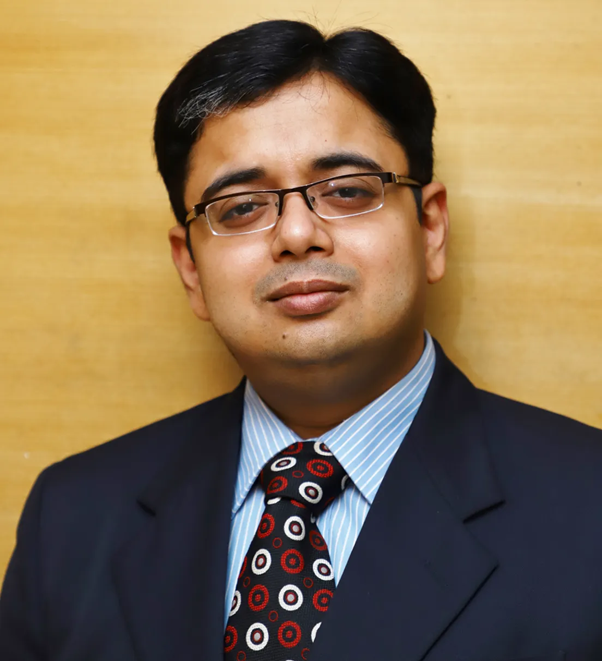
Dr. Arpan Kar
Indian Institute of Technology Delhi, India
Title: Computational theory building research for improving User Experience
Abstract:
A lot of trace data gets created across platforms when users interact with each other. Further, user reviews on different digital apps on platforms like play store create mechanisms to understand the golden truth hidden within trace data. These trace data are sources for truth, which are honest signals about customers’ feelings about your product or services. Mining these trace data with natural language processing enables generation of factors which can improve customer experiences or user experiences. However, for all digital platforms, the factors differ quite significantly and so understanding of literature surrounding human computer interaction becomes important to theorize about the technology. We will explore broader approaches and philosophies undertaken into computationally intensive theory building research for improving user experiences for digital applications and platforms.
Bio :
Prof. Arpan Kar is a Professor (Chair) in Information Systems in Indian Institute of Technology Delhi, India. He has a joint appointment in the Department of Management Studies and School of Artificial Intelligence. He chairs Information Systems Group and Corporate Affairs and is member of multiple administrative committees. He supports multiple ministries (DRDO, DST, MEiTY, Telecom, Cooperation) in different senior advisory/selection/policy committees and multiple universities (IITs/IIMs/etc) in faculty selection/promotion committees. He works on the appropriation and user experiences of emerging ICTs like artificial intelligence, social media, digital platforms, mobile apps, etc, often using computational mixed research methods. He has authored 180+ journal papers, 60+ conference papers, 30+ book chapters and 15 books, of which 100+ publications are in ABDC A, ABS 3 and WoS Q1 level journals, and 20 publications are in ABDC A* journals. He has over 30,000 citations and H index over 70. He has undertaken over 50 research, consultancy and training projects from organizations like BASF, PwC, Fidelity, EY, World Bank, Facebook, CIPPEC, Govt. of India (MEITY, DST, MoT, DRDO, MHRD, etc), which has generated revenue exceeding 300 Million INR. He is the Editor for Analytics Section in Applied Operations & Analytics (T&F, OR Society). He is Associate Editor in ABDC A journals like Communications of the AIS, Journal of Computer Information Systems, Global Journal of Flexible Systems Management, Int. J. of E-Govt Research, etc. He is in the Editorial Board for JSIS, GIQ, JBR, JGIM, etc. He was the Editor in Chief of IJIM Data Insights (2020-2024). He was earlier Senior / Associate Editor in Decision Support Systems, International Journal of Information Management, Journal of Public Affairs and Sage Open. He has been a Guest Editor for ABDC A* journals like JAIS, DSS, IJIM and IMM and ABDC A ranked journals like ISF, AJIS, etc. He has also been AE for SIs in MISQ, DSS, etc. He received the Research Excellence Award by Clarivate for highest WoS citations from 2015-2020. He received the BK Birla Distinguished Researcher Award for the count of ABDC A* publications over 5 years. He received 3 Best Seller Awards from Ivey / Harvard / The Case Center for his teaching cases. He received over 20 other awards like 3 IFIP Best Paper awards, ACM ICEGOV Best Paper, Careers 360 Outstanding Researcher Award, Tata Consultancy Services Gold Medal, Project Management Institute Award, AIMS Best Researcher, IIT Delhi Teaching Excellence, many reviewing awards, etc.

Dr. Edward T. Chow
NASA's Jet Propulsion Laboratory,
united states
Title: A Trustworthy Framework for Cross-Domain Autonomous AI Agent Collaboration
Abstract:
The growing deployment of autonomous AI agents across industrial, governmental, and cyber-physical systems introduces significant challenges in interoperability, trust, and secure coordination. Existing multi-agent architectures are frequently siloed, constrained by domain-specific data models and rigid APIs that limit cross-domain collaboration and governance transparency. This paper presents TAIAS (Trusted AI Agent System), a trusted AI agent framework designed to enable secure and autonomous collaboration across heterogeneous domains through semantic context sharing and smart contract–based governance.
TAIAS is built upon an IEEE 2874 Spatial Web–compliant Universal Domain Graph (UDG), which encodes spatial, temporal, regulatory, economic, and cyber contexts into a unified semantic structure. This shared semantic substrate allows agents to exchange contextualized semantic packets that preserve meaning across domains, enabling adaptive reasoning and dynamic coalition formation without centralized orchestration.
Trust enforcement is embedded through programmable smart contracts that define data access policies, compliance constraints, liability boundaries, and economic incentives. Policy agents provide real-time validation and auditability, while reputation mechanisms support adaptive trust modeling among autonomous actors.
The proposed framework contributes to trustworthy AI research by integrating semantic interoperability, decentralized governance, and cybersecurity enforcement within a unified operational framework for autonomous AI agents. TAIAS illustrates how resilient, transparent, and accountable cross-domain collaboration can be achieved in complex digital ecosystems, thereby supporting the development of trustworthy AI systems and secure digital infrastructures.
Bio :
Dr. Edward T. Chow currently serves as Manager of the Civil Program Office at the Jet Propulsion Laboratory (JPL), a federally funded research and development center managed by NASA Jet Propulsion Laboratory. In this role, he oversees the success of JPL programs with non-NASA civil agencies, including the U.S. Department of Homeland Security, U.S. Department of Energy, National Science Foundation, National Oceanic and Atmospheric Administration, U.S. Department of Commerce, and United States Geological Survey, while also fostering partnerships with academia, philanthropic institutions, and international governments. With more than twenty-five years of experience in advanced networking, cybersecurity, artificial intelligence, and high-performance computing, Dr. Chow has played a pivotal role in expanding JPL’s civil and defense technology portfolio, including tripling DARPA-related business revenue during his tenure as Manager of the Information System Projects Office. He served as Principal Investigator and Chief Architect for the Real-time Automated Insight Engine for Data to Decision (RAID) project, advancing human-like AI for distributed system-of-systems test automation, and as Deputy Director of the NASA/JPL Quantum Space Innovation Center. Earlier in his career, he led the NASA Secured Advanced Federated Environment (SAFE) project, deploying secure virtual enclaves across six NASA centers, and directed the NASA Collaborative Engineering Environment across ten centers agency-wide. His leadership also extended to global network video implementations for NASA’s Deep Space Network and to nationwide telemedicine demonstrations to the U.S. Congress involving major industry partners. In academia, he served as Research Associate Professor at the University of Southern California and as Assistant Professor at California State University, Fullerton, teaching graduate courses in computer engineering and networking. Dr. Chow earned his Ph.D. in Electrical Engineering from the University of Southern California (1988), an M.S. in Electrical and Computer Engineering from the University of Michigan (1981), and a B.S. in Electronic Engineering from Chung Yuan Christian University (1980). A recipient of the NASA Exceptional Engineering Achievement Medal and the JPL Lew Allen Award, he has authored numerous publications and patents spanning digital twins for lunar exploration, AI assistants for first responder safety, autonomous manufacturing, and advanced image processing, reflecting a distinguished career at the intersection of aerospace innovation, artificial intelligence, and collaborative engineering.
Invited Speakers
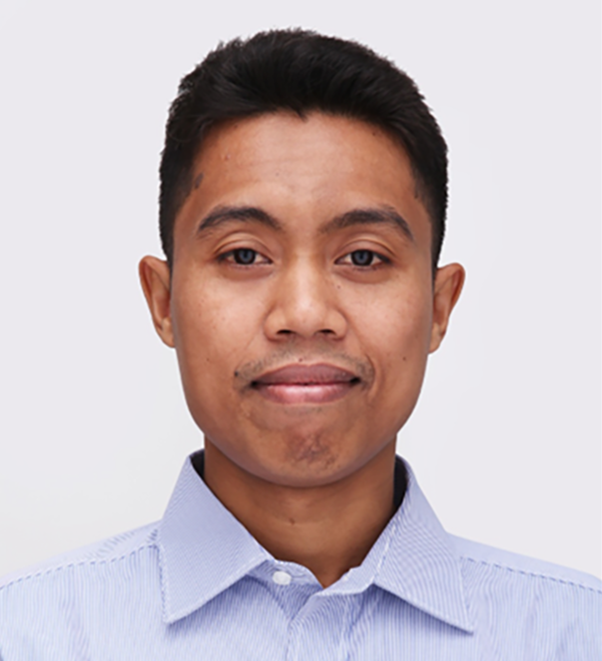
Dr. Muhammad Ali Fauzi
Universitas Brawijaya, Indonesia
Title: Trustworthy AI by Design: Integrating Privacy-Preserving Learning and Explainability in Sensitive Domains
Abstract:
Artificial Intelligence is increasingly deployed in sensitive domains such as healthcare, education, finance, and digital identity systems. While AI delivers strong predictive performance, its use in high-stakes environments raises concerns about privacy, transparency, fairness, and accountability. Trustworthiness must therefore be embedded into AI systems from the beginning. This talk presents the concept of “Trustworthy AI by Design,” built on two core pillars: privacy-preserving learning and explainability. We examine how federated learning and differential privacy enable collaborative model development without centralized data sharing, reducing privacy risks and supporting regulatory compliance. We also discuss explainable AI techniques that make model decisions more transparent and understandable to stakeholders. Through examples from digital health, behavioral biometrics, and educational analytics, the talk illustrates how integrating privacy and explainability enhances system reliability, user trust, and societal acceptance. Rather than limiting performance, these principles strengthen robustness and long-term sustainability. The session concludes with key research challenges and future directions for building AI systems that are not only powerful, but also ethical and trustworthy.
Bio :
Muhammad Ali Fauzi is a faculty member at the Faculty of Computer Science, Universitas Brawijaya, Indonesia. He received his Ph.D. in Information Security and Communication Technology from Norwegian University of Science and Technology (NTNU), Norway. His academic and research career spans interdisciplinary areas at the intersection of Artificial Intelligence, cybersecurity, and privacy-preserving machine learning.
His research focuses on trustworthy AI, behavioral biometrics, federated learning, digital health analytics, and explainable AI for high-stakes decision-making. He has led and collaborated on international research initiatives involving privacy-preserving authentication, AI-driven healthcare systems, and educational data analytics, with particular attention to ethical, legal, and societal implications. His work emphasizes integrating privacy and transparency directly into AI system design.
In addition to his research, he plays an active role in international academic collaboration, leading strategic partnerships, joint research programs, and global mobility initiatives. He has delivered invited talks and workshops on AI security, privacy-preserving learning, and responsible AI adoption in sensitive domains.

Dr. Deborah Fels
Toronto Metropolitan University, Canada
Title: Inclusion and AI: New opportunities and challenges.
Abstract:
Inclusion for people with disabilities, like many other disciplines, has experienced new and exciting trajectories offered by the developments in AI. From automatic live captions to producing alt text, some aspects of inclusion have seen significant growth and integration into mainstream content and practices due to ease of production and reduction in costs; common arguments against inclusive practices. Accessible content is becoming a “standard of good practice” rather than needing threats of legal action, or constant agitation by users and advocacy organizations for more and better legislation, and regulations. While AI has contributed to this new state of inclusion, there are many issues that still need research and resolution. Three different inclusive AI projects that demonstrate possible new uses of AI towards improved live closed captioning and quality assessment, support for neurodiverse job seekers, and use of qualitative video data to analyze and visualize a patient’s chronic pain journey will be presented along with cautionary caveats.
Bio :
Dr. Fels has a PhD (1994) in Human Factors from Industrial Engineering at the University of Toronto. She is currently employed as a professor in the Ted Rogers School of Information Technology Management, and the Director of the Inclusive Media and Design Centre at Toronto Metropolitan University. Her research interests involve inclusive design, access to media and technology for people with disabilities and older adults, and inclusive business. She has published over 190 articles on inclusive technologies and applications and received three patents.
Committee
International Advisory Board
– Borworn Papasratorn, King Mongkut’s University of Technology Thonburi, Thailand
– Gerald Quirchmayr, University of Vienna , Austria
– Irwin King, The Chinese University of Hong Kong, China
– Samir Chatterjee, Claremont Graduate University, United States
General Chairs
– Narongrit Waraporn, King Mongkut’s University of Technology Thonburi, Thailand
– Arpan Kar, Indian Institute of Technology Delhi., India
Program Committee Chairs
– Vajirasak Vanijja, King Mongkut’s University of Technology Thonburi, Thailand
– Suree Funilkul, King Mongkut’s University of Technology Thonburi, Thailand
Steering Committee
– Ashish Ghosh, Indian Statistical Institute, India
– Didi Rosiyadi, M.Kom, National Research and Innovation Agency (BRIN), Indonesia
– Pornchai Mongkolnam, King Mongkut’s University of Technology Thonburi, Thailand
– Simon Fong, University of Macau, Macau
– Sung-Bae Cho, Yonsei University, Korea
– Vajirasak Vanijja, King Mongkut’s University of Technology Thonburi, Thailand
Organizing Committee
Finance Chair : Vajirasak Vanijja, King Mongkut’s University of Technology Thonburi, Thailand
Organizing Committee Chair : Suree Funilkul, King Mongkut’s University of Technology Thonburi, Thailand
Publication Chair : Debajyoti Pal, King Mongkut’s University of Technology Thonburi, Thailand
Publicity and Virtual Exhibits Chair :Tuul Triyason, King Mongkut’s University of Technology Thonburi, Thailand
International Program Committee
– Amy Yeo, Tunku Abdul Rahman University of Management and Technology, Malaysia
– Anderson Teoh, Tunku Abdul Rahman University of Management and Technology, Malaysia
– Angkul Kongmunvattana, George Mason University, USA
– Azizul Azizan, Universiti Teknologi, Malaysia
– Chan Choon Kit, Tunku Abdul Rahman University of Management and Technology, Malaysia
– Claudio Angione, Teesside University, United Kingdom
– Eugene Cheng-Xi Aw, UCSI University, Malaysia
– Gerald Quirchmayr, University of Vienna, Austria
– Kazuki Kobayashi, Shinshu University, Japan
– Kazushi Ikeda, Nara Institute of Science and Technology, Japan
– Kuan Yee Nee, Tunku Abdul Rahman University of Management and Technology, Malaysia
– Lai Weng Kin, Tunku Abdul Rahman University of Management and Technology, Malaysia
– Lance Chun Che Fung, Murdoch University, Australia
– Masaru Fukushi, Yamaguchi University, Japan
– Osama Halabi, Qatar University, Qatar
– Pascal Bouvry, University of Luxembourg, Luxembourg
– Pranab Roy, JK Lakshmipat University, Jaipur, India
– Pruthikrai Mahatanankoon, Illinois State University, United States
– Saifurrahman Sabuj, BRAC university, Bangladesh
– Sudip Ghosh, Indian Institute of Engineering Science and Technology, Shibpur, India
– Susmita Ghosh, Jadavpur University, India
– Tasnim Ferdous, BRAC University, Bangladesh
– Thinagaran Perumal, University Putra Malaysia, Malaysia
– Worrawat Engchuan, The Centre for Applied Genomics, Sickkids Hospital, Canada
– Xiangmin Zhang, Wayne State University, United States
Local Program Committee
– Apinporn Methawachananont, National Electronics and Computer Technology Center, Thailand
– Apivadee Piyatumrong, Big Data Institute (Public Organization), Thailand
– Atcharaporn Yokkhun,Yala Rajabhat University, Thailand
– Boonserm Kaewkamnerdpong, King Mongkut's University of Technology Thonburi, Thailand
- Chakarida Nukoolkit, King Mongkut's University of Technology Thonburi, Thailand
– Charnsak Srisawatsakul, Stamford International University, Thailand
– Ekapong Jungcharoensukying, King Mongkut’s University of Technology Thonburi, Thailand
– Kitsuchart Pasupa, King Mongkut’s Institute of Technology Ladkrabang, Thailand
– Kittichai Lavangnananda, King Mongkut’s University of Technology Thonburi, Thailand
– Mongkhon Thakong, Udon Thani Rajabhat University, Thailand
– Monvorarat Pongpaiboon, IBM, Thailand
– Nantaporn Ratisoontorn, National Electronics and Computer Technology, Thailand
– Narasak Boonthep, University of Phayao, Thailand
– Nuttanont Hongwarittorrn, Thammasat University, Thailand
– Orasa Patsadu, Rajamangala University of Technology Krungthep, Thailand
– Peerapon Siripongwutikorn, King Mongkut's University of Technology Thonburi, Thailand
– Peerumporn Jiranantanagorn, Rajamangala University of Technology Rattanakosin, Thailand
– Pisal Setthawong, Assumption University, Thailand
– Pizzanu Kanongchaiyos, Chulalongkorn University, Thailand
– Pornpat Sirithumgul, Rajamangala University of Phra Nakorn, Thailand
– Punnarumol Temdee, Mae Fah Luang University, Thailand
– Richard Watson Todd, King Mongkut''s University of Technology Thonburi, Thailand
– Sansanee Auephanwiriyaku, Chiang Mai University, Thailand
– Sotarat Thammaboosadee, Mahidol University, Thailand
– Suchada Sitjongsataporn, Mahanakorn University of Technology, Thailand
– Suwat Pattaramalai, King Mongkut's University of Technology Thonburi, Thailand
– Thammarsat Visutarrom, Prince of Songkla University, Thailand
– Theerachet Soorapanth, National Electronics and Computer Technology Center, Thailand
– Waransanang Boontarig, Ubon Ratchathani Rajabhat University, Thailand
– Werapon Chiracharit, King Mongkut's University of Technology Thonburi, Thailand
– Wichian Chutimaskul, King Mongkut's University of Technology Thonburi, Thailand
– Wilawan Rukpakavong, Thammasat University, Thailand
Important Dates
| Milestone | Date |
|---|---|
Date of Conference : |
|
Paper Submission Deadline : |
|
Notification of Acceptance : |
|
Registration Deadline : |
|
Camera Ready : |
|
Program
- June 17, 2026
- June 18, 2026 (AM)
- June 18, 2026 (PM)
- June 19, 2026 (AM)
- June 19, 2026 (PM)
SCHEDULE
|
8.30 – 17.30
Registration & Badge Pickup (ongoing all day) |
|
10.30 – 12.45
Join Zoom Meeting
AI Automation Workshop (Online): Build AI Workflows with n8n + Local AI Model |
SCHEDULE
|
8.00 – 8.45
Registration
|
|||||
|
9.00 – 9.45
IAIT 2026 Open Ceremony
Welcome by Prof. Narongrit Waraporn (Dean of School of IT, KMUTT) |
30th Anniversary Address by the Dean, School of Information Technology, KMUTT |
Greetings from IEEE CIS Thailand Chapter
|
|||||
|
10.00 – 10.40 | KEYNOTE 1 (Online)
Prof. Arpan Kar (Indian Institute of Technology Delhi, India)
“Computational Theory Building Research for Improving User Experience”
Join Zoom Meeting |
|||||
|
10.40 – 10.55 | Short Coffee Break
|
|||||
|
Session 1: JSCI Special Session Session Chair: Assoc. Prof. Dr. Pornchai Mongkolnam, KMUTT, Thailand |
Session 2: Large Language Models, RAG, and Prompt Engineering Session Chair: Asst. Prof. Dr. Chakarida Nukoolkit, KMUTT, Thailand |
Session 3: AI-Enhanced Education and Learning Technologies Session Chair: Dr. Muhammad Ali Fauzi, UB, Indonesia |
|||
|---|---|---|---|---|---|
| 11.00 – 11.20 |
YOLO – Based IoT Tracking for Academic Labs on Raspberry Pi
(#7039) Tamakorn Jiamrachada, Sarayut Nonsiri, Pichitchai Kamin and Nathaphon Nanthajirapong |
11.00 – 11.20 |
Evidence Retention Is Not Sufficient for Answerability:
A Diagnostic Study of Context Budgeting for Small Language Model RAG
(#2106) Seowan Kim and Jinhong Yang |
11.00 – 11.20 |
Enhancing LLM Tutors with Retrieval-Augmented Generation
and Chain-of-Verification for Curriculum-Grounded Formative Feedback:
A Case Study on Thai Health Education
(#0225) Patiphan Kaseteiam and Vajirasak Vanijja |
| 11.20 – 11.40 |
Monitoring Irrigated Wheat in Afghanistan:
Systematic Literature Review
(#8871) Hamid Momand, Watanyoo Suksa-Ngiam, Debajyoti Pal and Pornchai Mongkolnam |
11.20 – 11.40 |
Hallucination in Retrieval-Augmented Generation
is a Context Construction Problem:
A Constraint-Driven Cross-Modal Framework
(#3321) Victor Okolie |
11.20 – 11.40 |
A Persona-based Automated Evaluation Framework
for Intelligent AI Teaching Assistants
(#0293) Chananyu Limcharoen, Keetaphat Sripinta and Kitsuchart Pasupa |
| 11.40 – 12.00 |
Lilit to Ramakien:
A Five-Work Benchmark for LLM Understanding
of Classical Thai Literature
(#9846) Tuul Triyason |
11.40 – 12.00 |
A comparison of local LLMs in paragraph decomposition context
(#5598) Chayada Muangboonsri, Nattawadee Wuttivoradit, Nannicha Phraemetta, Bunthit Watanapa and Vithida Chongsuphajaisiddhi |
11.40 – 12.00 |
Context-Aware Hybrid Probabilistic Model
for Portfolio-Based Recognition of Prior Learning
(#0334) Stephen O. Omondi, Joseph Muliaro Wafula and Agnes N. Mindila |
| 12.00 – 12.30 |
JSCI Special Talk Dr. Punnarust Silparattanawong “From Algorithms to Artistry: The Evolution of Intelligent NPC Behavior” |
12.00 – 12.20 |
Prompt Compression for Diffusion Large Language Models:
An Empirical Evaluation of LLMLingua-2 and LLaDA
(#6030) Sterling Huang, Abigayle Brown, Jiyoo Noh, Amy Xu, Vanessa Huo, Kaung Myat Kyaw and Jonathan H. Chan |
12.00 – 12.20 |
Beyond the Veneer of Competence:
How Structured Prompting Fosters Knowledge Transfer
in LLM-Augmented Education
(#3510) I-Ting Lin, Chia-Hao Chiu, Shao-Hsuan Lin, Ko-I Lee and You-Siang Huang |
| 12.20 – 12.40 |
A Structured Prompt Design Algorithm
for Contextual Health Data Extraction
in Elderly Virtual Companion Systems
(#8298) Prissadang Suta and Pornchai Mongkolnam |
12.20 – 12.40 |
Modelfile Engineering for Offline B2 English Tutoring
(#5849) Kantima Techadisai and Booncharoen Sirinaovakul |
||
| 12.40 – 13.00 |
Comparative Analysis of Algorithms and Implementation
for Course Recommendation System
(#8334) Akkarawit Sittiprakan, Papangkorn Kijsakulrat, Natsaran Sae-Oueng, Umaporn Supasitthimethee and Niwan Wattanakitrungroj |
||||
SCHEDULE
| 12.45 – 13.55 | Lunch | |||||
|
14.00 – 14.40 | INVITED TALK 1
Dr. Muhammad Ali Fauzi (Universitas Brawijaya, Indonesia)
“Trustworthy AI by Design: Integrating Privacy-Preserving Learning and Explainability in Sensitive Domains”
|
|||||
| 14.40 – 15.00 | Short Coffee Break | |||||
|
Session 4: Trustworthy Generative AI, Fact Verification,
and Compliance Chatbots
Session Chair: Assoc. Prof. Jonathan H. Chan, KMUTT, Thailand |
Session 5: Agentic, Decentralized, and Interactive AI Systems
Session Chair: Dr. Edward T. Chow, NASA Jet Propulsion Lab, USA |
Session 6: Human-Centered Recommendation and Digital Services
Session Chair: Dr. Deborah Fels, TMU, Canada |
|||
|---|---|---|---|---|---|
| 15.00 – 15.20 |
Managing Hallucination Risk in LLM-Generated Outputs:
The Roles of Prompting Literacy, Trust Calibration,
and Verification Behavior
(#0118) Tam Nguyen Thanh and Phu Nguyen Huynh Hoai |
15.00 – 15.20 |
Model-Specific Echo Chamber Formation Patterns in Repeated
LLM Agent Networks
(#3698) Soohyun Jo, Junbeom Kim, Seunghyeon Lee and Hong-Woo Seok |
15.00 – 15.20 |
Making Invisible Work Visible:
A Rule-Based Digital Coordination Model
for Inclusive Back-Office Workplaces
(#0067) Weena Nitipaparnan, Parames Chutima and Panita Surachaikulwattana |
| 15.20 – 15.40 |
Robustness Limits of Claim-Only Fact Verification:
A Controlled Comparison of Classical, Neural,
and Transformer Models
(#6461) Daniil Suvorov, Iryna Afanasieva, Kostiantyn Onyshchenko, Nataliia Golian and Vira Golian |
15.20 – 15.40 |
Deterministic Blackboard Pipelines with Specialized
LLM Knowledge Sources:
A Generalizable Architecture for Intelligent
Multi-Stage Reasoning
(#6099) Tim Bass |
15.20 – 15.40 |
Virtue-Based Thai Folktale Recommendation
with Ensemble LLMs
(#4087) Wassana Daeng-Am, Anuntapat Anuntachai and Ponrudee Netisopakul |
| 15.40 – 16.00 |
A Generative AI Tool for Constructing Web Frontend
with Integration of Quality Feedback Loop
(#8158) Warinporn Walloppornlapak and Twittie Senivongse |
15.40 – 16.00 |
Phebe: A Multi-Agent Natural Language Interface
for Interactive Data Visualization
(#7577) Guntawit Anurakboonying, Ratchaphon Proongpattanaskul, Chalantorn Sawangwongchinsri and Tanasanee Phienthrakul |
15.40 – 16.00 |
Personalized Health Insurance Recommendation with
Retrieval-Augmented Generation:
A Study of Lexical, Dense, and Hybrid Retrieval
(#8941) Phakon Rujireksareekul, Anuntapat Anuntachai and Ponrudee Netisopakul |
| 16.00 – 16.20 |
A Validation and Governance Framework for Multi-Agent
LLM Scientific Software Development
(#9799) Tim Bass |
16.00 – 16.20 |
Towards Dynamic QR Representation of Large Verifiable
Documents via IPFS Driven Decentralized Storage and
Blockchain State Commitments
(#8762) Brigita Carolina, Fauzan Khifzan and John Choi |
16.00 – 16.20 |
AI Exposure, Role Change, and Innovation Behaviour
in a Large Norwegian Bank:
A Job Demands-Resources Perspective
(#6773) Marit Oppen |
| 16.20 – 16.40 |
Enhancing AI Chatbots for Privacy Compliance:
Implementing a Prototype for Retriving Regulations
from EU GDPR, Thailand PDPA, and Australian APPs
through Local LLMs and RAG Techniques
(#2236) Charnsak Srisawatsakul, Waransanag Boontarig, Gerald Quirchmayr, Thanatat Wongabut and Sukanya Chinwicha |
16.20 – 16.40 |
Agent-as-an-Asset:
A Virtual Marketplace on Blockchain
for Distributed Agentic Workflows
(#9461) Goshgar Can Ismayilov |
16.20 – 16.40 |
Lumina:
Seasonal Color Analysis System
with Explainable Machine Learning
(#2424) Ngwe Yee Pearl Ou and Jonathan Hoyin Chan |
| 18.00 onwards | Banquet (The Great Harbour) | |||||
SCHEDULE
|
09.50 – 10.30 | KEYNOTE 2
Dr. Edward T. Chow (NASA Jet Propulsion Laboratory, USA)
“A Trustworthy Framework for Cross-Domain Autonomous AI Agent Collaboration”
|
|||||
|
10.30 – 10.45 | Short Coffee Break
|
|||||
|
Session 7: Financial AI, Trading, and Market Intelligence Session Chair: Prof. Dr. Suganya G, Vellore Institute of Technology, India |
Session 8: Decision Intelligence, ESG, and Operational Analytics |
Session 9: Cybersecurity, Privacy, and Threat Intelligence Session Chair: Assoc. Prof. Dr. Vajirasak Vanijja, KMUTT, Thailand |
|||
|---|---|---|---|---|---|
| 10.45 – 11.05 |
Wavelet-Based Multiresolution Analysis of Commodity Market Dependencies:
Gold, Silver and WTI Crude Oil
(#0523) Kanit Jompuk and Chutiporn Anutariya |
10.45 – 11.05 |
Analyzing ESG Cluster Characteristics of Thai Equity Market Sectors
using Unsupervised Machine Learning
(#5907) Paweenuch Tanpornwattan, Bunthit Watanapa and Chakarida Nukoolkit |
10.45 – 11.05 |
Vulnerability Analysis for CBT Exam System
(#0715) Chalita Maksakha and Vajirasak Vanijja |
| 11.05 – 11.25 |
Stock Price Prediction from Multi Data Sources Using LSTM,
FinBERT and BERTweet
(#2162) Suchart Auensupa, Ponrudee Netisopakul and Supannada Chotipant |
11.05 – 11.25 |
Machine Learning Models for Multi-Horizon Classification
of Bitcoin Future Price Movements
(#6803) Sirawat Boonpai, Ponrudee Netisopakul and Anuntapat Anuntachai |
11.05 – 11.25 |
Thai Threat News Classification Using Open-Source LLMs:
A Comparative Evaluation of Models and Prompt Strategies
(#1516) Badeesorn Sittikong, Jiratunth Rahman, Thirawat Kongnil, Tuul Triyason, Chonlameth Arpnikanondt and Vithida Chongsuphajaisiddhi |
| 11.25 – 11.45 |
A Comparative Study of Deep Reinforcement Learning Agents
for Gold Trading with Technical Indicators and
LLM-Filtered News Sentiment
(#2521) Thanapong Thanasarn, Anuntapat Anuntachai and Ponrudee Netisopakul |
11.25 – 11.45 |
Dynamic Toll Lane Configuration Using Q-Learning
in SUMO-Based Bangkok Case Study
(#2211) Thee Nandar Soe, Ei Ei Mon and Chaodit Aswakul |
11.25 – 11.45 |
Organizational Support as a Mediator:
Understanding Security Behavior Toward
Network-Connected Printers in the Workplace
(#7250) Nirachora Chuenjai and Tuul Triyason |
| 11.45 – 12.05 |
Duration-Aware Student-t Hidden Semi-Markov Modeling
for Financial Time-Series Decision Support
(#4191) Akara Kijkarncharoensin and Sutthirak Sookkhasem |
11.45 – 12.05 |
Forecasting Surgical ICU Bed Availability Using Routine Operational Data
and Machine Learning
(#9230) Orathai Kongchana, Vajirasak Vanijja and Chaitawat Sa-Ngamuang |
11.45 – 12.05 |
Hybrid GCN-LSTM for Privacy-Preserving Fall Detection
in Human Pose-Based Elderly Monitoring Systems
(#4735) Tuan Nguyen Van, Tam Nguyen Thanh and Luan Nguyen Trong |
| 12.05 – 12.25 |
Feature Selection for HMM Regime Detection:
An Empirical Characterization of Volatility and Trend Features
in Equity Markets
(#5147) Jiakang Xu, Kaung Myat Kyaw and Jonathan H. Chan |
12.05 – 12.25 |
Machine Learning-Based Prediction of Settled Water Turbidity
for Optimizing Alum Dosage in Drinking Water Treatment
(#8417) Piyapong Juntarasomboon, Chutiporn Anutariya and Chonlameth Arpnikanondt |
12.05 – 12.25 |
Source-Level Detection of Private Data Collection Misuse
and Build-Preserving Mitigation of Write-Transaction Return Leakage
in LLM-Generated Hyperledger Fabric Chaincode
(#6705) Sungmoon Park and Jinhong Yang |
| 12.25 – 12.45 |
Stage-Aware Detection of Altcoin Price Bubbles
Using Attention-Based LSTM and Multi-Source Sentiment Signals
(#5212) Chih-Chieh Hung, Liang-Chi Huang and Chuang-Chieh Lin |
||||
|
12.45 – 14.00 | Lunch
|
|||||
SCHEDULE
|
14.00 – 14.40 | INVITED TALK 2
Dr. Deborah Fels (Toronto Metropolitan University, Canada)
“Inclusion and AI: New opportunities and challenges”
|
|||||
| 14.40 – 15.00 | Short Coffee Break | |||||
|
Session 10: Data Governance, AI Policy, and Digital Transformation
Session Chair: Dr. Debajyoti Pal, KMUTT, Thailand |
Session 11: Edge-IoT, Robotics, and Smart Cyber-Physical Systems
Session Chair: Assoc. Prof. Dr Charnsak Srisawatsakul, Stamford International University, Thailand |
Session 12: Computer Vision, Multimodal Recognition,
and Applied Machine Learning
Session Chair: Asst. Prof. Dr. Chonlameth Arpnikanondt, KMUTT, Thailand |
|||
|---|---|---|---|---|---|
| 15.00 – 15.20 |
Towards a data model for mapping the PDPA onto the EU’s GDPR
[Towards a data model for mapping the Personal Data Protection Act (PDPA)
of Thailand onto the European General Data Protection Legislation (GDPR)]
(#2125) Worarat Krathu, Sunisa Sathapornvajana, Maleerat Maliyaem, Hathairat Ketmaneechairat, Guntur Budi Herwanto, Edgar Weippl, Gerald Quirchmayr and A Min Tjoa |
15.00 – 15.20 |
AMRF: A Software Architecture for Autonomous Mobile Robot
Fleet Management in Warehouse Environments
(#4517) Norawit Nangsue, Tammarat Shubanchong, Teerapat Kasemvesaruchawut, Bhirabhat Klomjit, Thadchai Suksaran and Wuttichai Visarnkuna |
15.00 – 15.20 |
Transfer Learning for Constellation Recognition:
A Comparative Study of Lightweight CNNs on Small-Scale
Astronomical Image Data
(#0959) Kelzang Yuden, Ziaullah Momand, Pornchai Mongkolnam and Debajyoti Pal |
| 15.20 – 15.40 |
From Data Governance to Contract-Constrained AI Systems:
Architecture and Evaluation for Enterprise NL-to-SQL
with AI-Ready Data Models
(#3066) Ümit Erdem Saltan |
15.20 – 15.40 |
Smart Shopping: Design of an Automated Cart System
using EM-18 RFID Reader Module
(#7588) Divanshu Jain, Pranab Roy, Debajyoti Pal, Niyati Soni and Akbar Khan |
15.20 – 15.40 |
Adapting Vision Transformer Models for Thai Cat Breed
Classification via Dataset Augmentation and
Class Cardinality Reduction
(#1509) Nudhana Sarutipaisan, Prechaya Maksap, Chawisa Keawphinit and Bunthit Watanapa |
| 15.40 – 16.00 |
Operational Governance Controls for AI Data Operations:
A Scenario-Based Review Framework
(#4564) Shuo Han and Ning Mou |
15.40 – 16.00 |
Design and Implementation of Fynix Trans-Lens:
A Wearable Edge-IoT Translation Glasses System
for Real-Time Multilingual Communication
(#9284) Phu Nguyen, Duy Tan Do, Khoi Pham Nguyen Hoang, Tam Nguyen Thanh, Tan Duong and Luan Nguyen Trong |
15.40 – 16.00 |
Cross-Modal Emotion Discrepancy Detection:
Detecting When Voice Reveals Emotions
That Text Conceals
(#1691) Kaung Hset Hein and Jonathan Chan |
| 16.00 – 16.20 |
SAFE AI: Designing a Gender-Responsive and Child-Safe AI Framework
(#4575) Henny Rosalinda, Dewi Yanti Liliana and Saseendran Pallikadavath |
16.00 – 16.20 |
“3DFoodColorMatch”:
A demo for color transformation of plant-based meat substitutes
using 3D food printing technology
(#1677) Narinee Ninthongkam, Veerapat Dujyongthummakhun, Shisanucha Chengsamo and Punnarust Silparattanawong |
16.00 – 16.20 |
KOPNet++:
Ordinal Contrastive Learning for Intermediate-Stage Detection
in Knee Osteoporosis Grading
(#2990) Saranya M and Suganya G |
| 16.20 – 16.40 |
Digital Transformation Maturity Model for Higher Education Institutions:
A Qualitative Analysis of Assessment Frameworks
(#8465) Ghulam Ali Amiri, Watanyoo Suksa-Ngiam, Pornchai Mongkolnam, Suree Funilkul and Debajyoti Pal |
16.20 – 16.40 |
A Parameter-Efficient Cascaded Framework
for Mosquito Species Identification using MFCC Features
(#2064) Natchapol Kiriwanna, Chakarida Nukoolkit and Tuul Triyason |
16.20 – 16.40 |
Geometry-Aware Foundation Makeup Simulation
Using Radiative Transfer Models
(#3490) Soe Thandar Lwin, Ye Thu, Chonlameth Arpnikanondt and Thanatat Wongabut |
| 16.40 – 17.00 |
Data Localization in Practice:
A Network Benchmarking Study of Cloud Compliance Costs
for Thai Public Sector
(#6912) Tuul Triyason |
16.40 – 17.00 |
A Systematic Review and Empirical Validation of Intelligent
Machine Learning-Based Soft Sensor Frameworks
for Biochemical Oxygen Demand Estimation
(#5192) Jonardo Asor and Chutiporn Anutariya |
16.40 – 17.00 |
Backbone Selection for Packaging Defect Classification:
A Controlled Study of Accuracy, Robustness,
and Computational Efficiency
(#9531) Amonpan Chomklin, Siam Yamsaengsung, Pornchai Mongkolnam and Niwan Wattanakitrungroj |
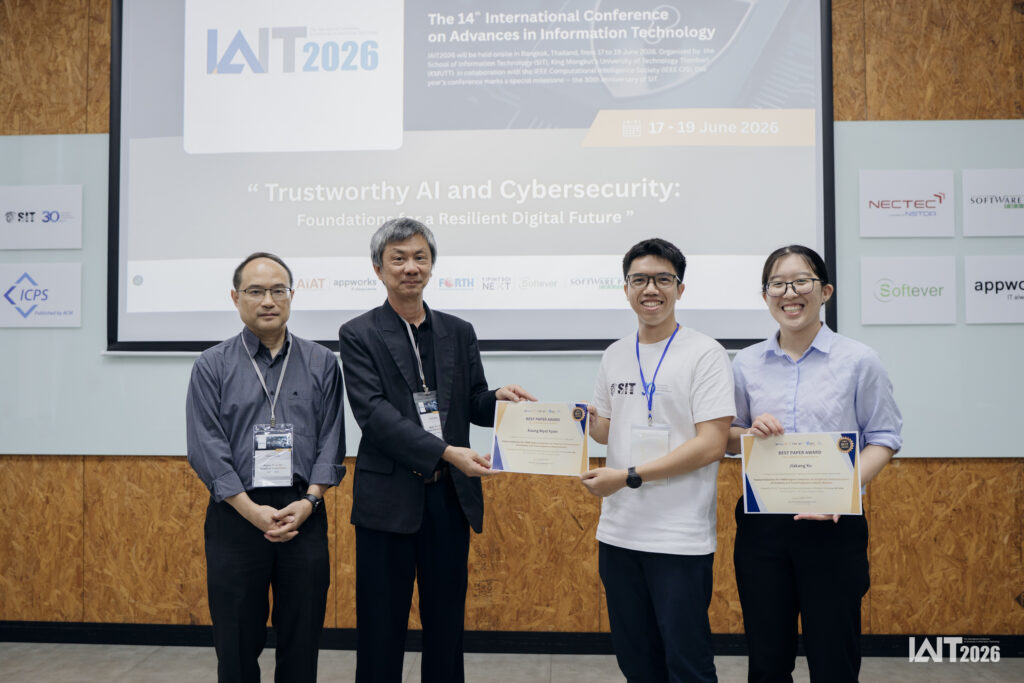
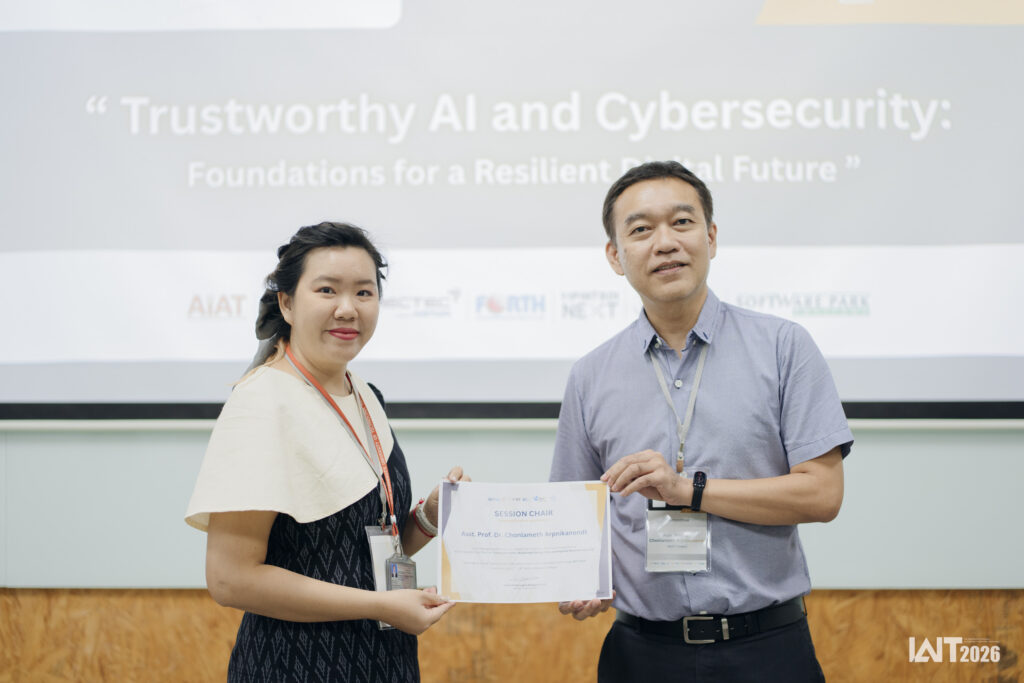
| 17.00 – 17.30 Award Distribution and Closing Remarks | |||||
History
Technical Sponsors



Our Sponsors






Venue
Knowledge Exchange Center (KX)
10th Floor
110/1 Krung Thon Buri Road, Bang Lamphu Lang, Khlong San, Bangkok,
Thailand 10600
Tel : (66) 02-470-7906
Hosted by :
School of Information Technology (SIT)
King Mongkut’s University of Technology Thonburi (KMUTT)
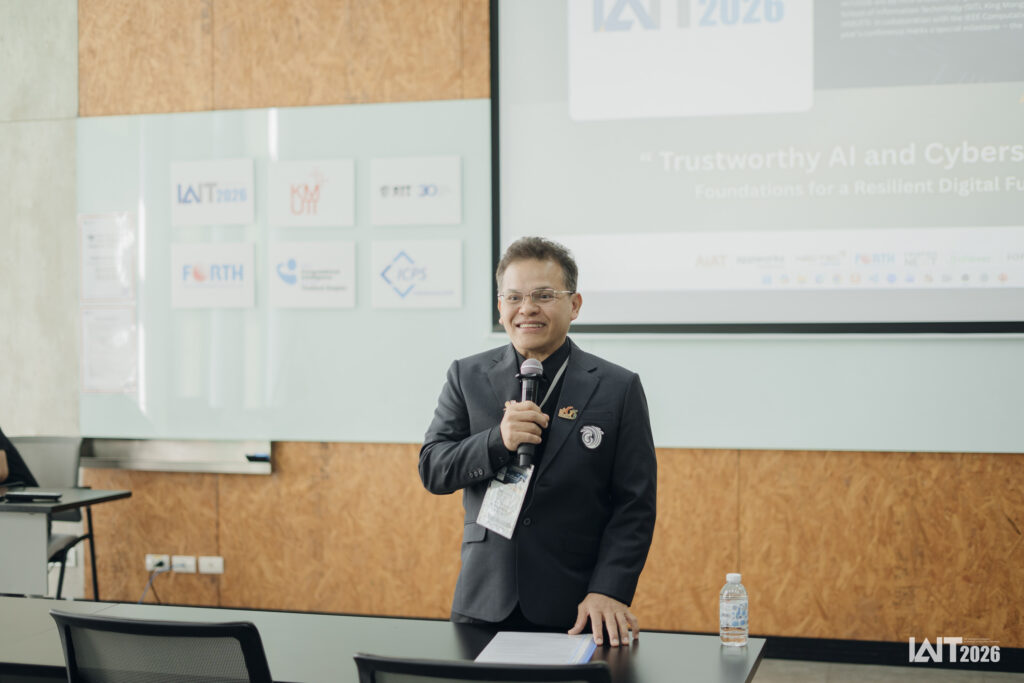
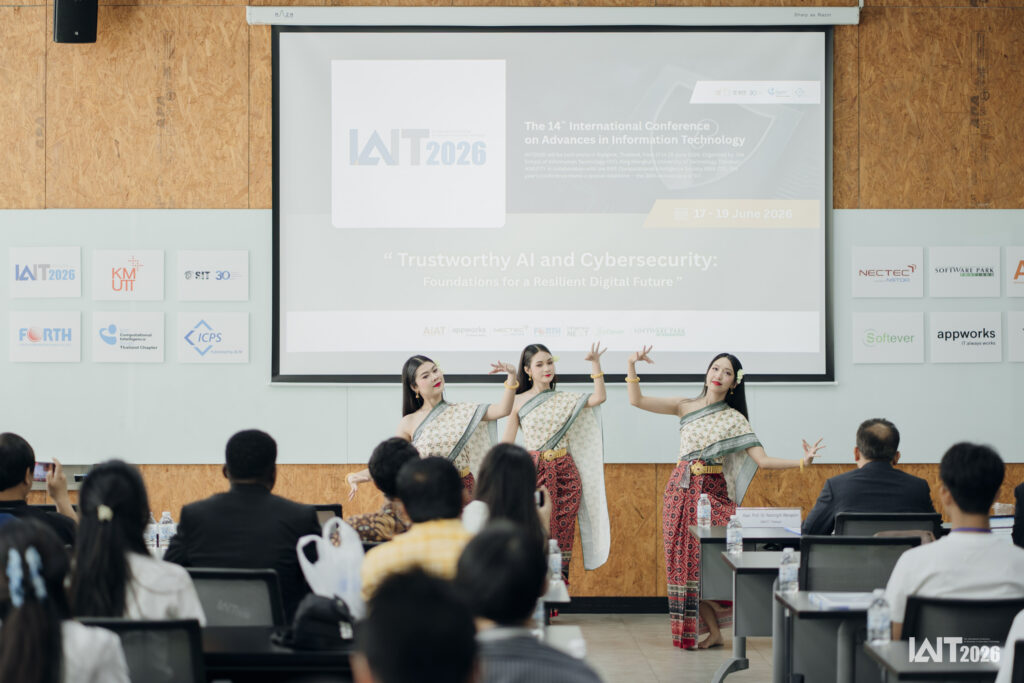
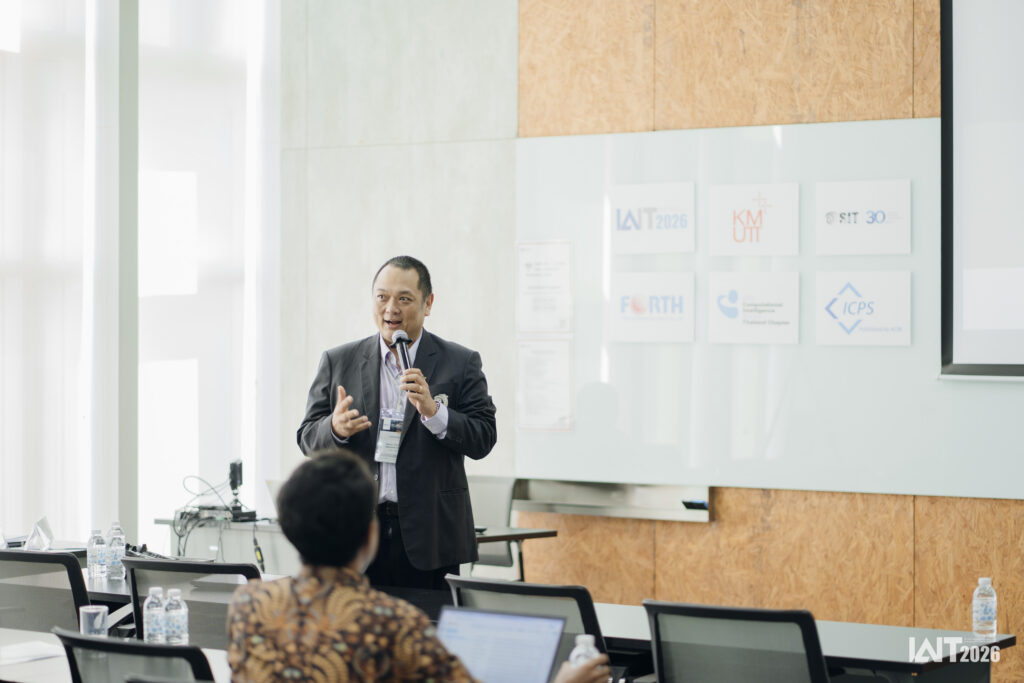
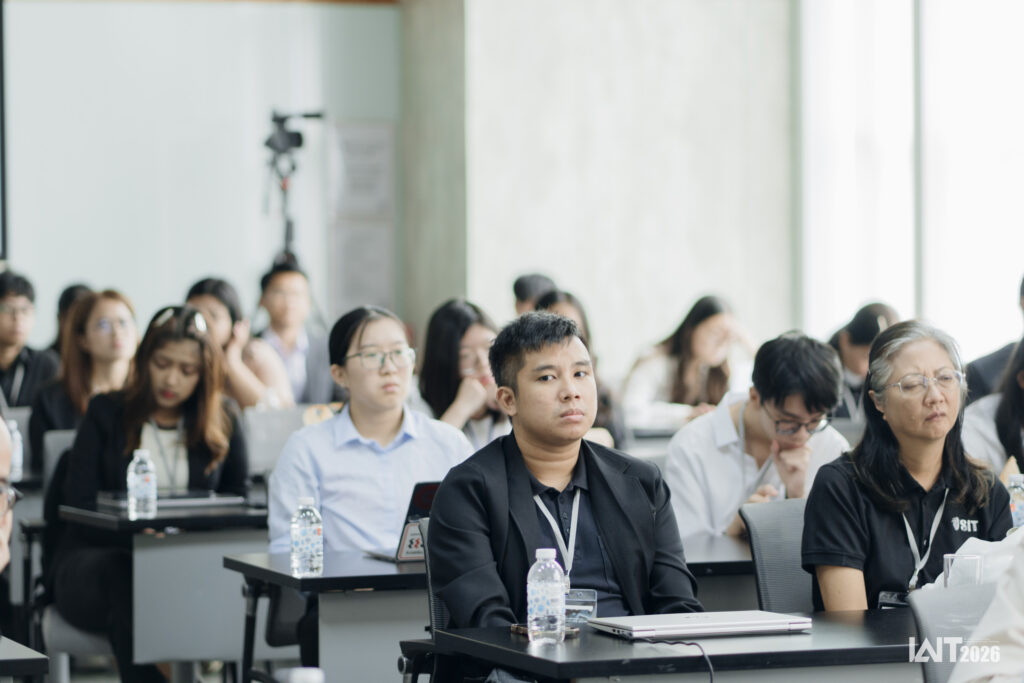
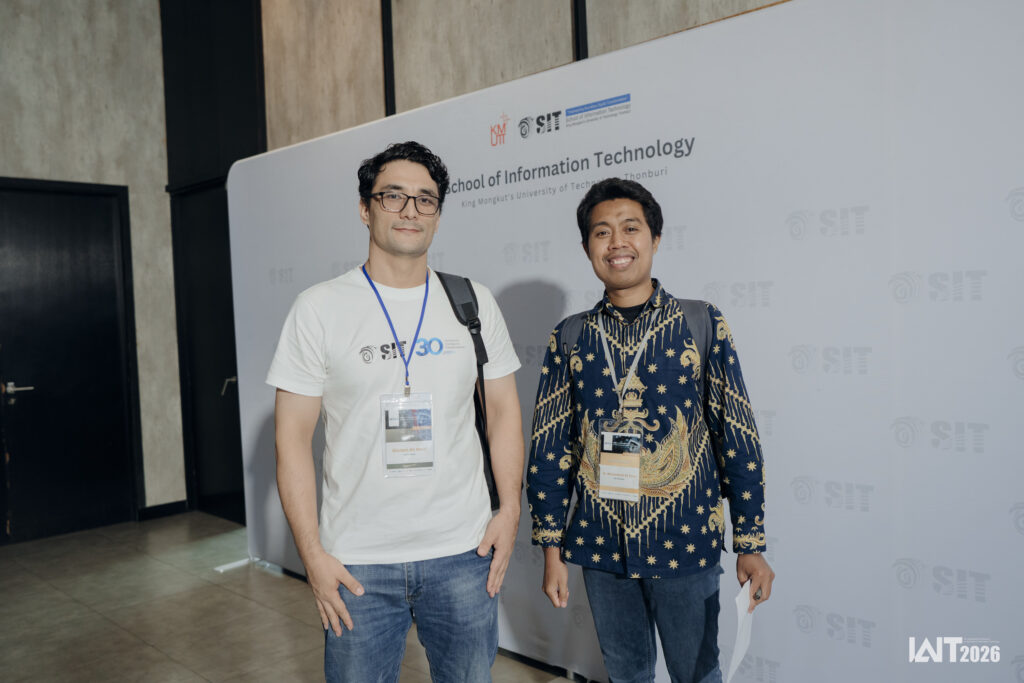
The conference will be conducted on-site and feature keynote talks, technical sessions, student presentations, and networking events. A special celebration will be held to commemorate 30 years of SIT’s academic and research excellence.
Hotel
Recommended Accommodation for IAIT2026 Participants Venue Partner Hotel
Away Bangkok Riverside Kene
 Stay Period: 17 – 20 June 2026
 Special room rates for IAIT2026 participants (including breakfast for 2 persons, tax, and service charge) :
- Chill Room — THB 1,700/night
- Chill with Bathtub — THB 2,000/night
- Cool Room — THB 2,300/night
- Cool Pool Side — THB 3,200/night
📍 Complimentary benefits:
- Breakfast at Marni Restaurant
- Welcome drink upon arrival
- Free Wi-Fi throughout the hotel
- In-room coffee & tea station
- Access to swimming pool and fitness center
 Booking Information
Booking Code: KMUTT
Reservation Deadline: 10 June 2026
Email Reservation:
rsvn.abr@awayresorts.com
Booking Information
Booking Code: KMUTT
Reservation Deadline: 10 June 2026
Email Reservation:
rsvn.abr@awayresorts.com
Participants are requested to book directly with the hotel and mention the booking code “KMUTT” to receive the special rate.
Hilton Garden Inn Bangkok Riverside
📅 Stay Period: 15 – 21 June 2026
🗓 Booking Period: Now – 12 June 2026
✨ Special Offer for IAIT2026 Participants
- 25% discount from the hotel’s Best Available Rate
- Breakfast included
- Reservations can be made through the official conference booking link
📍 Hotel Highlights
- Riverside hotel located on Charoen Nakhon Road
- Opposite ICONSIAM shopping complex
- Convenient access to the BTS Gold Line
- Easy access to the conference venue via connecting BTS service at Krung Thon Buri Station
- Complimentary Wi-Fi, fitness center, and outdoor swimming pool with panoramic Bangkok views
📌 Reservation Policy
- Full prepayment is required at the time of booking
- Non-refundable reservation
🔗 Reservation Link
Hilton Garden Inn Bangkok Riverside for IAIT 2026
https://hil.tn/ougp0w
Participants are encouraged to book early, subject to room availability.
Contact Us !
📌 iait2026@sit.kmutt.ac.th
📌 Official Website : www.iait-conf.org
Join Us !
Be part of IAIT2026 and help shape the future of secure, responsible, and human-centered technologies. We look forward to welcoming you to Bangkok in June 2026!